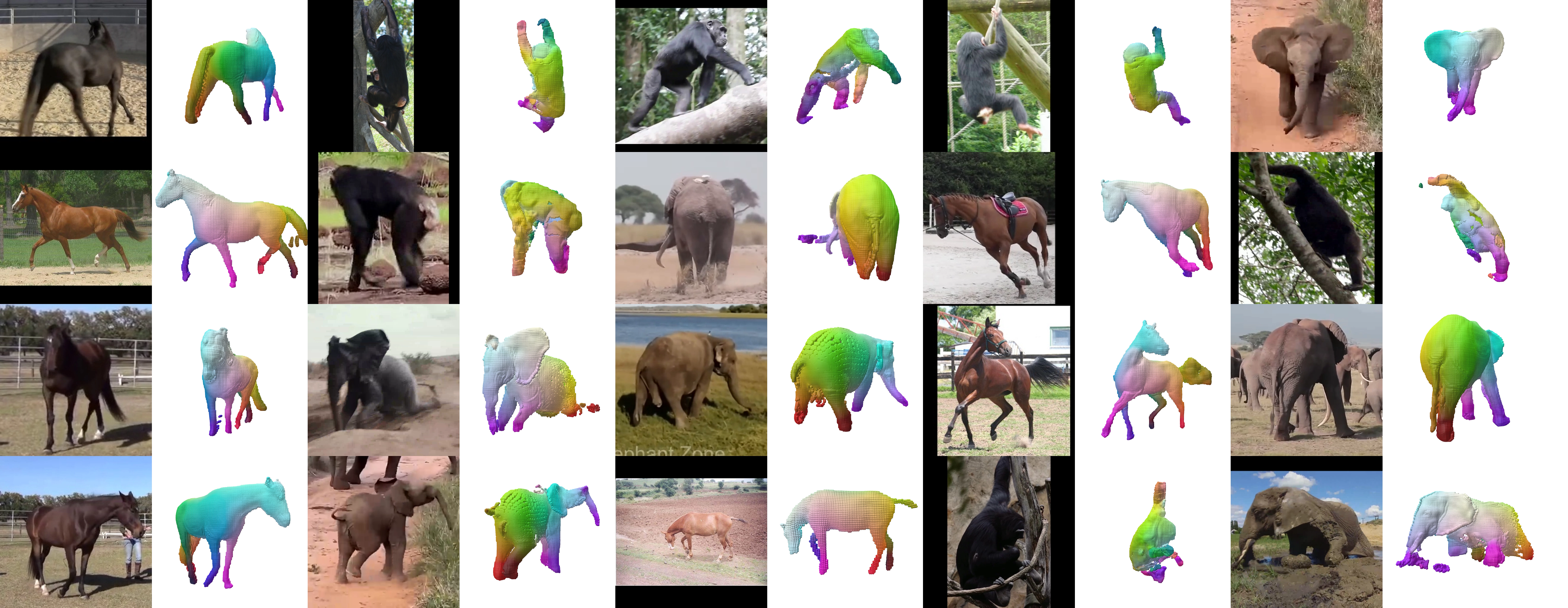
Results with SAM-3D and Trellis.2
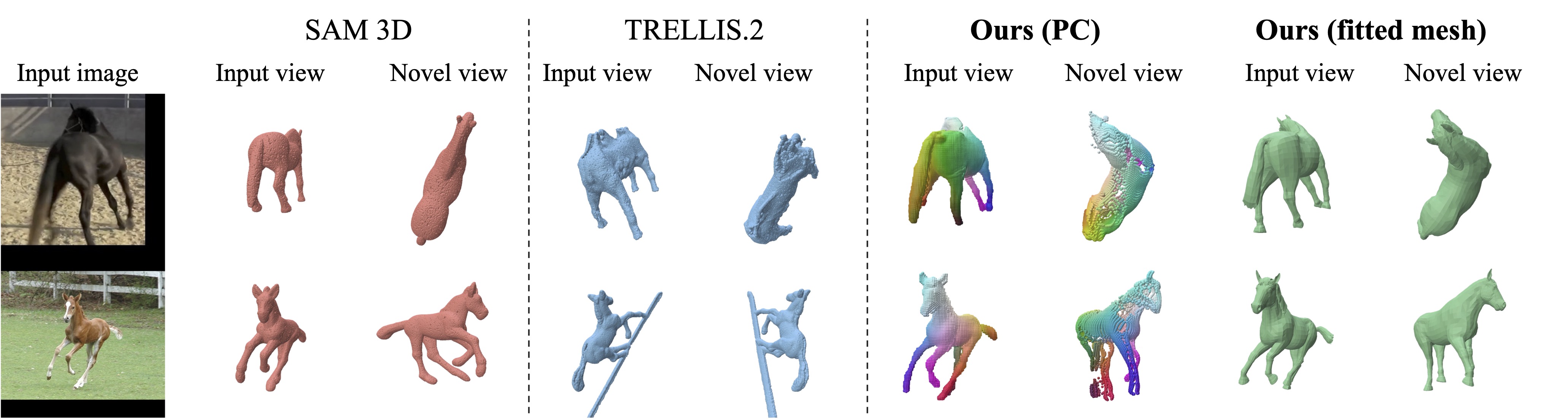
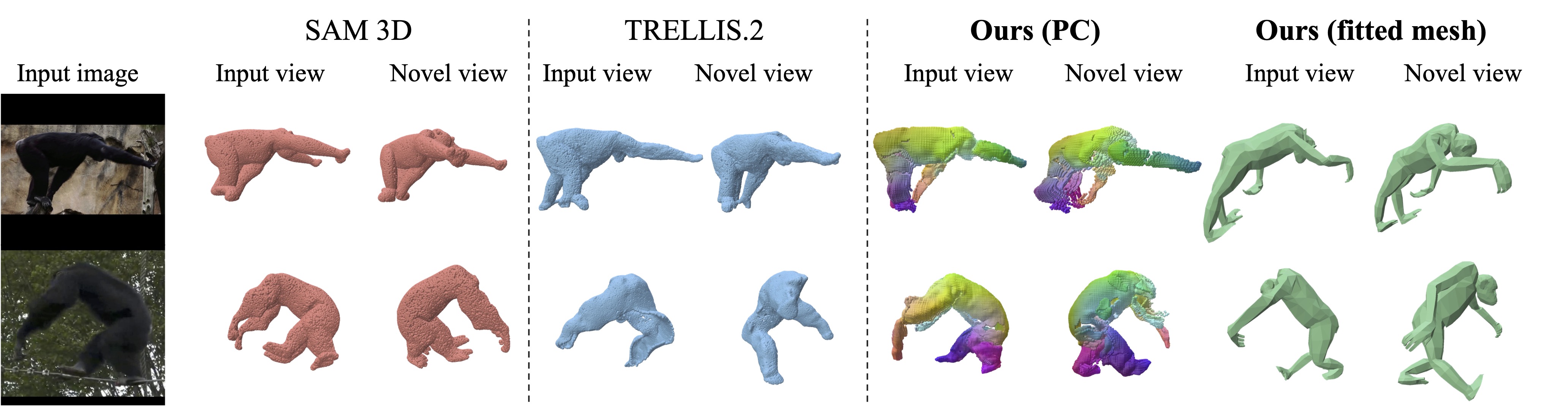
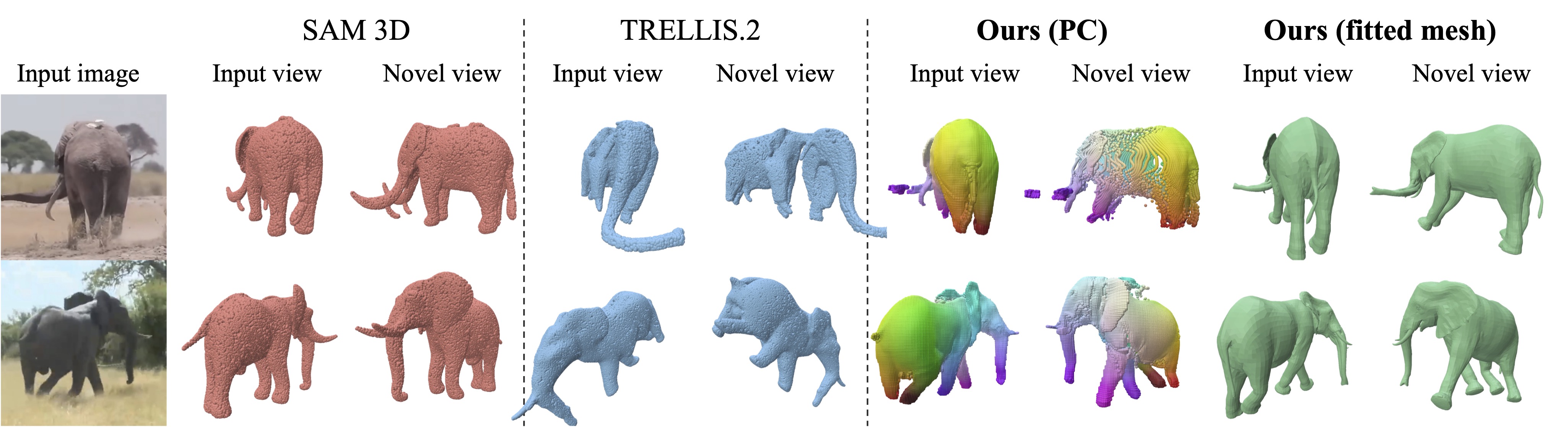
Qualitative comparisons to foundation models on real-world images across diverse categories.
3D reconstruction of articulated objects from a single image is challenging because large training datasets with paired image and 3D supervision are difficult to obtain. Recent point map–based methods achieve strong performance but rely on synthetic datasets rendered from manually created articulated 3D assets with carefully curated pose distributions. While camera viewpoints can be easily sampled, generating realistic object articulations remains costly and labor-intensive. We propose a training framework that reduces this requirement by leveraging unannotated 2D images collections with only a single rigged canonical mesh per category.
Starting from a weak 3D shape predictor trained on canonical-pose renders, we iteratively estimate object articulation and camera pose by fitting the mesh to predicted point maps. The recovered articulations and viewpoints are then used to render updated synthetic training data, progressively improving the predictor. Despite using substantially weaker 3D supervision, our models achieve performance comparable with DualPM, which requires manually curated articulated training datasets.
Qualitative comparisons to foundation models on real-world images across diverse categories.
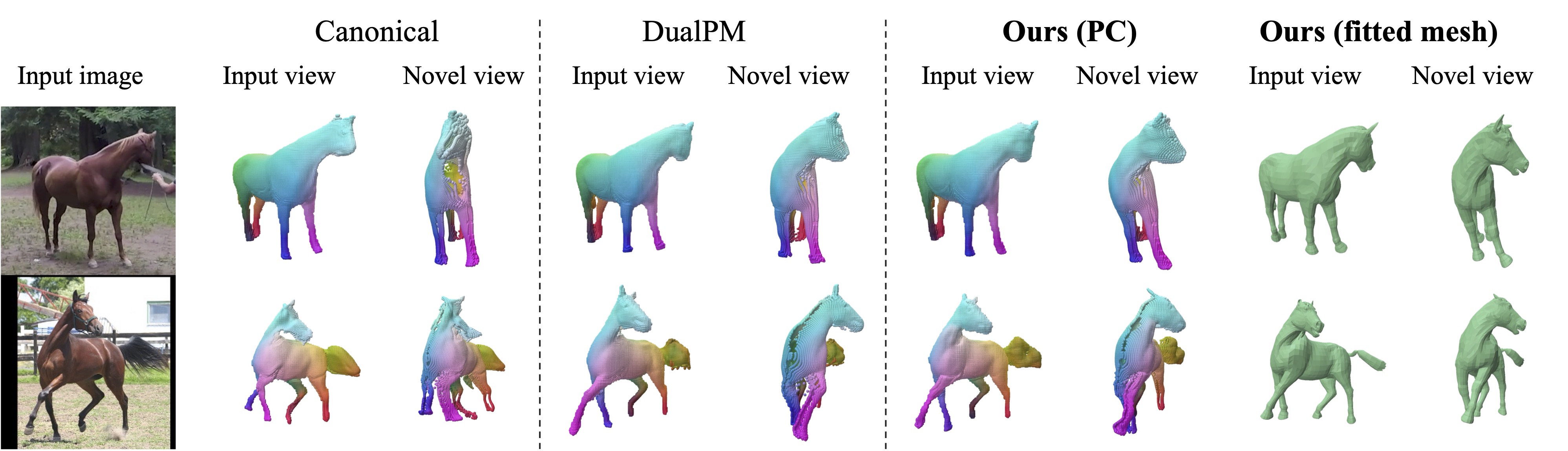
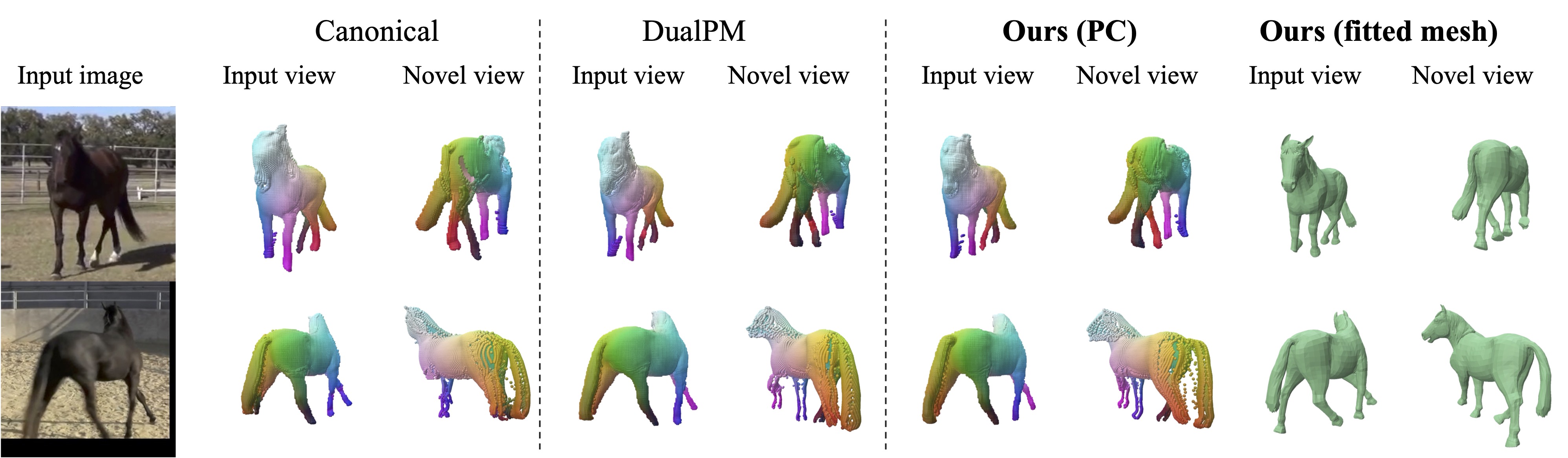
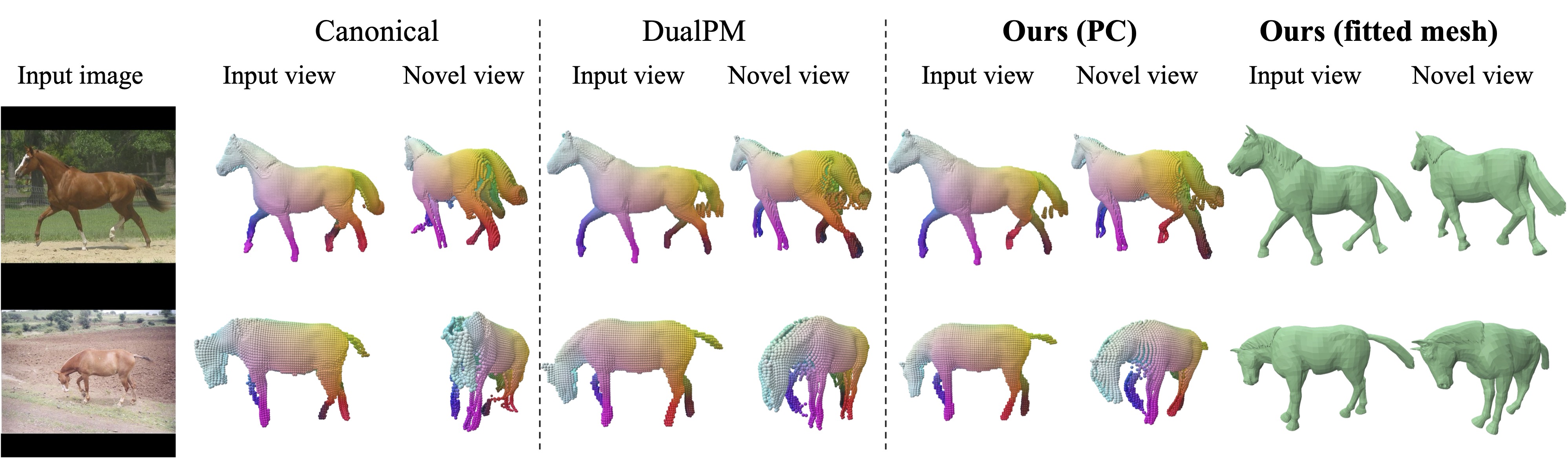
Visualizing point cloud predictions and extracted fitted meshes across ablation settings.
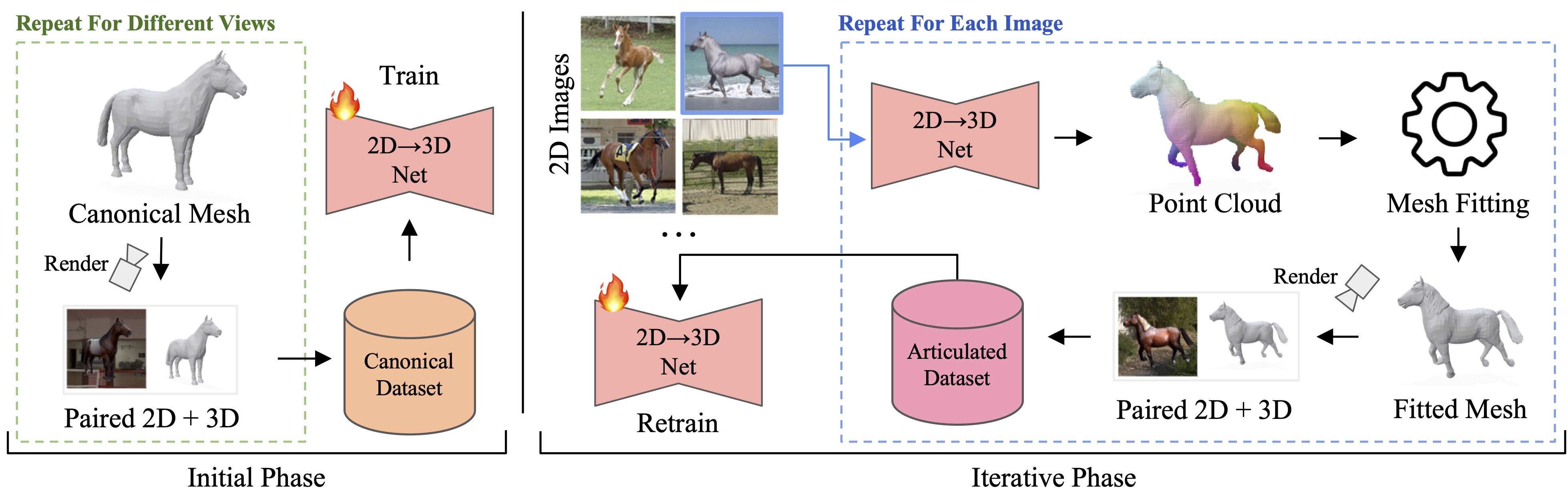
(Left) We render the canonical rigged mesh from sampled camera viewpoints to create an initial paired 2D--3D training set, which is used to train the initial 2D to 3D predictor. (Right) Given an image collection, the current predictor predicts posed and canonical point maps. We fit the canonical mesh to these predictions, recover an articulated mesh and camera viewpoint, and render the result to obtain new synthetic training pairs with exact point-map supervision. The predictor is then retrained on this generated dataset, yielding an improved model. The process is repeated for 4 iterations.
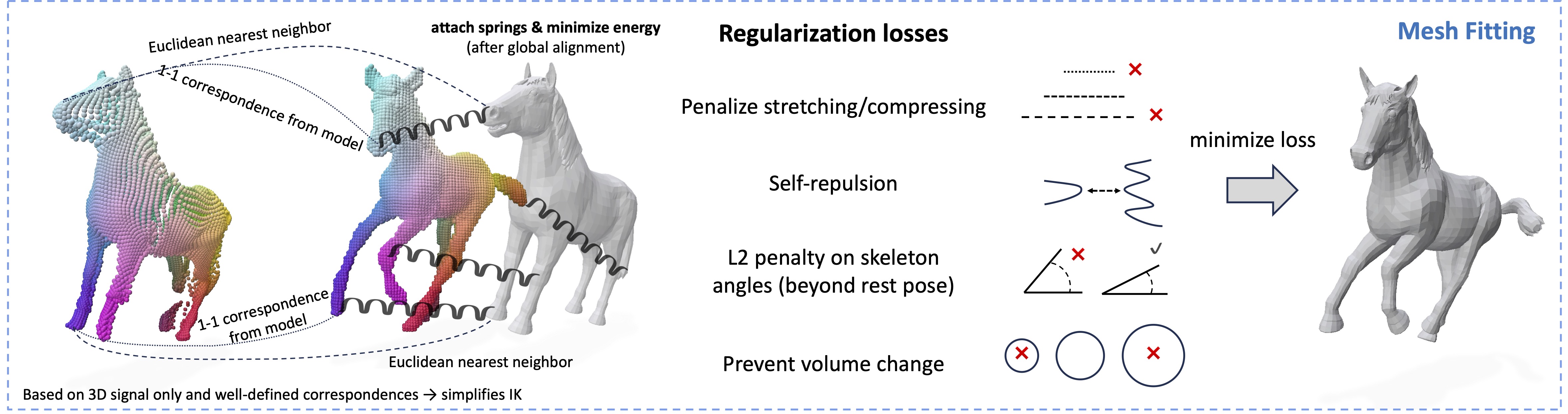
The mesh fitting step cleans up noisy 3D predictor outputs and provides dense 3D supervision for subsequent training rounds. We first establish correspondences between template vertices and predicted posed points by chaining 1-to-1 point predictions with nearest-neighbor search in canonical space. After globally aligning rotation, translation, and scale, we connect corresponding points with virtual springs and minimize the system's deformation energy. To ensure physically plausible reconstructions, geometric regularizers penalize edge distortion and volume changes, prevent mesh self-intersections, and regularize joint angle offsets from the rest pose to promote smooth articulations.
@misc{zadrozny2026bootstrapping,
      title={Bootstrapping Articulated 3D Reconstruction from 2D Image Collections},
      author={Jakub Zadrozny and Oisin Mac Aodha and Hakan Bilen},
      year={2026},
      eprint={2607.03891},
      archivePrefix={arXiv},
      primaryClass={cs.CV},
      url={https://arxiv.org/abs/2607.03891},
}